
- Brak
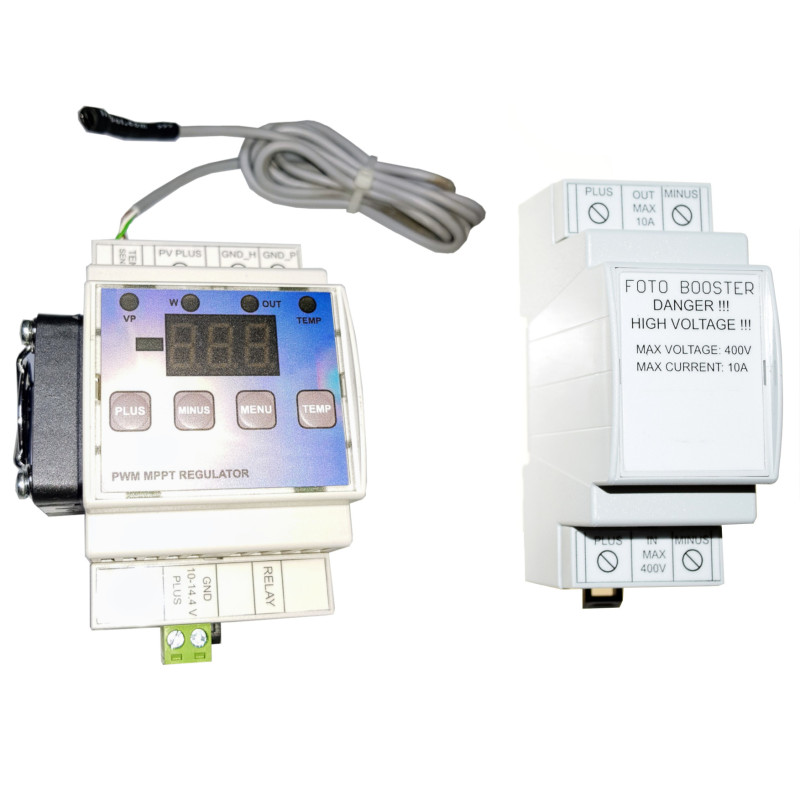


The controller enables powering standard domestic hot water electric boiler heaters (operating at 230V or 110V AC) from PV solar panels.
A photovoltaic panel operates at maximum power only at an optimal voltage. Connecting a heater directly to a photovoltaic panel causes it to be overloaded too much, resulting in a voltage drop. At a reduced operating voltage, the panel produces even several times less electricity than at the optimal voltage. The use of a charge controller eliminates this problem. Even on cloudy days, it will be possible to heat water in the boiler.
A buffer module containing capacitors, a choke, and diodes is added to the controller, which allows for higher efficiency (by up to 30%) and reduction of interference caused by PWM regulation.
The controller has been equipped with a temperature sensor, which allows for stopping the boiler heating above the set temperature.
The device is equipped with an additional relay output (potential-free) allowing external devices to be notified that water heating has finished (target temperature reached) or that a device failure has occurred. This output allows for connecting additional devices.
EAN: 6931240073919 SKU: 739155867
PWM controller for heating elements with an MPPT maximum power point tracking algorithm for photovoltaic panels.
The controller enables powering standard domestic hot water electric boiler heaters (operating at 230V or 110V AC) from PV solar panels.
A photovoltaic panel operates at maximum power only at an optimal voltage. Connecting a heater directly to a photovoltaic panel causes it to be overloaded too much, resulting in a voltage drop. At a reduced operating voltage, the panel produces even several times less electricity than at the optimal voltage. The use of a charge controller eliminates this problem. Even on cloudy days, it will be possible to heat water in the boiler.
A buffer module containing capacitors, a choke, and diodes is added to the controller, which allows for higher efficiency (by up to 30%) and reduction of interference caused by PWM regulation.
The controller has been equipped with a temperature sensor, which allows for stopping the boiler heating above the set temperature.
The device is equipped with an additional relay output (potential-free) allowing external devices to be notified that water heating has finished (target temperature reached) or that a device failure has occurred. This output allows for connecting additional devices.
Parameters
Supply voltage: from 11V to 14.4V DC
Panel voltage: from 10V to 400V DC
PV panel current: up to 11A. The controller has a function that allows safe operation with PV panels generating higher currents than 11A. If the PV panel generates a current greater than 11A, the controller will supply a maximum of 11A to the heater. In practice, it is extremely rare for a PV panel that generates 13A of current in ideal conditions to exceed 11A (it must be ideal temperature, ideal sunlight, and a new PV panel).
Maximum heater power: 2kW
Maximum panel power: 2kW
Current drawn from the power supply without cooling: 0.08 A
Current drawn from the power supply with cooling: 0.23A
Temperature measurement accuracy 0.1°C
Operating modes
The controller has the ability to change the mode to operate between min and max voltage.
First mode:
It is fully automatic and starts working immediately after connection. When the input voltage exceeds the minimum voltage threshold (MINUS button), the controller starts sending current to the heater using the MPPT maximum power point tracking algorithm.
If the voltage drops below the minimum value, MPPT searching is interrupted and the current to the heater stops flowing. Setting the minimum value allows for free water heating and at the same time allows for battery charging.
Second mode:
Possibility to set activation voltage thresholds (from which the PWM value starts increasing) and maximum voltage (from which the duty cycle is 100%), i.e., all cell energy goes directly to the heater.
Additionally, the use of this method allows keeping the panels at the MPPT point (maximum power point).
Additional information
Controller dimensions: 90x54x64mm
Buffer dimensions: 90x36x64mm
Temperature sensor cable length: about 100cm
What heater should I use AC or DC and what power?
Since the only parameter describing the heater is resistance, you can use an AC or DC heater.
The heater should be matched to the photovoltaic panels.
If your photovoltaic panels nominally provide 140V DC 7.14A 1000W, the most appropriate will be to use a 140V DC heater with a power of 1000W,
but you can also use a 230V AC or 110V AC heater. You only need to match the heater power to the PV panels. (we provide an online calculator to calculate the correct heater).
According to the above, (because the only heater parameter is its resistance, as well as current) it is possible to match a 230V heater to work with PV panels of a different voltage, using Ohm's law. 140V / 7.14A = 19.61 Ohm. Our heater is to have 19.61 Ohm. For a 230V heater P=U*U/R.P=230*230/19.61=2697W. For 140V 7.14A PV panels, we can therefore use a 230V AC heater with a power of about 2700W.
Other examples:
For 4x 400W PV panel with an operating voltage of 36V of one PV panel, you can use a standard 220V AC heater with a power of 3 to 3.5kW
For 4x 450W PV panel with an operating voltage of 38V of one PV panel, you can use a standard 220V AC heater with a power of 3.8 to 4.5kW
For 4x 500W PV panel with an operating voltage of 40V of one PV panel, you can use a standard 220V AC heater with a power of 3.5 to 4kW
Heaters can have two independent coils. One coil can be used for heating water from PV panels and the other from the 230V network.
To connect the controller to the heater, it is safer to use a heater with a single coil.
Set contents
Controller
Charge buffer
Temperature sensor
Cable connectors (depending on the batch)
Packaging
Manual
Certificates and standards
CE, RoHS
Dimensions, Weight
Product dimensions: 90 x 54 x 64 mm (Depth x Width x Height)
Packaging dimensions: 100 x 120 x 60 mm (Depth x Width x Height)
Product weight: 330 g
Weight with packaging: 376 g
Specific References
The controller enables powering standard domestic hot water electric boiler heaters (operating at 230V or 110V AC) from PV solar panels.
A photovoltaic panel operates at maximum power only at an optimal voltage. Connecting a heater directly to a photovoltaic panel causes it to be overloaded too much, resulting in a voltage drop. At a reduced operating voltage, the panel produces even several times less electricity than at the optimal voltage. The use of a charge controller eliminates this problem. Even on cloudy days, it will be possible to heat water in the boiler.
A buffer module containing capacitors, a choke, and diodes is added to the controller, which allows for higher efficiency (by up to 30%) and reduction of interference caused by PWM regulation.
The controller has been equipped with a temperature sensor, which allows for stopping the boiler heating above the set temperature.
The device is equipped with an additional relay output (potential-free) allowing external devices to be notified that water heating has finished (target temperature reached) or that a device failure has occurred. This output allows for connecting additional devices.