1 Purpose and Functions
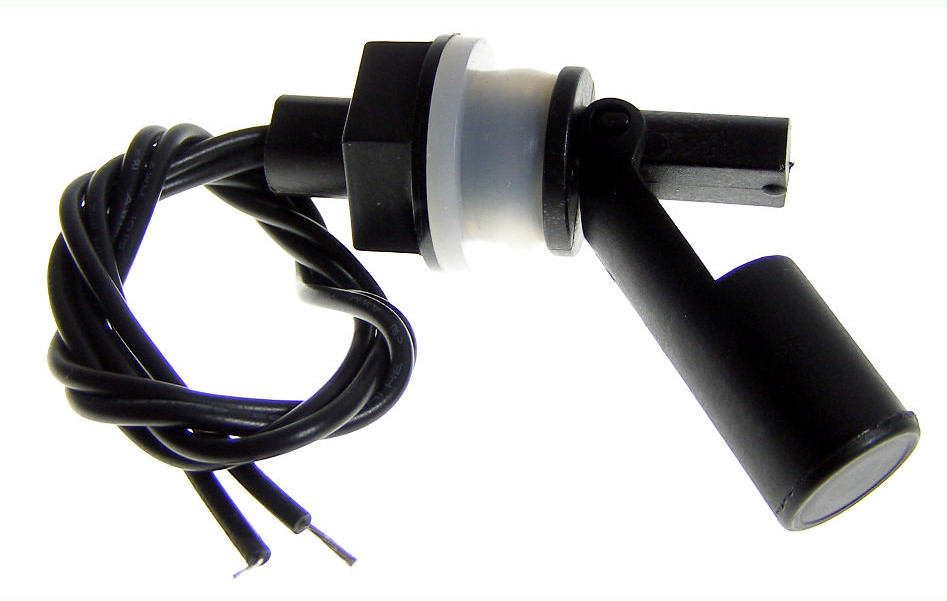
A float liquid level sensor (on/off switch) is a reliable solution designed for precise monitoring of fluid levels in tanks. The device is designed for side mounting on the outside of the tank, which significantly simplifies installation due to the use of a sealing flange and a robust M16 thread with a nut. The probe is extremely versatile; depending on the mounting method, it can control both the high and low liquid levels, serving as an overflow sensor or dry run protection.
Main features:
- ✔ Robust polypropylene (PP) construction
- ✔ External side mounting using M16 thread
- ✔ Operation in NO or NC mode
- ✔ Safe automation using SSR relays
- ✔ Resistance to water, sewage, and oils
Operating principle:
The heart of the device is a float with a built-in magnet. Under the influence of the liquid's buoyancy, the float moves along the tube, which causes the hermetic reed switch built inside to close or open. This construction guarantees longevity and resistance to difficult operating conditions. The sensor is made of high-quality polypropylene (PP), allowing it to be used in contact with various substances, such as water, sewage, or oils.
2 Technical Specifications
| Max switching voltage | 300V AC/DC |
| Max switching current | 0.5A |
| Max switching power | 50W |
| Contact layout | NO (normally open) or NC (normally closed) |
| Material | Polypropylene (PP) |
| Operating temperature | -10 ~ +85 °C |
| Wire length | 30 cm |
| Mounting | M16 external thread with nut |
| Gasket | Rubber, black |
| Product dimensions | 25 x 25 x 86 mm |
| Product weight | 30 g |
3 Assembly and Configuration
Mechanical installation:
The sensor is mounted horizontally in the side wall of the tank. Drill a hole with a diameter corresponding to the M16 thread, then insert the sensor from the inside or outside (depending on the tank design) and tighten the nut, ensuring the rubber gasket is correctly positioned for a proper seal.
Changing the operation mode (NO/NC):
The device allows choosing the operation mode depending on the installation requirements:
- NO mode (Normally Open): The circuit is closed when the liquid level raises the float.
- NC mode (Normally Closed): The circuit is broken when the liquid level raises the float.
Operation mode configuration is achieved by rotating the sensor 180 degrees along its axis during installation or by removing the safety clip and reversing the float on the tube.
4 Connection Diagrams and Safety
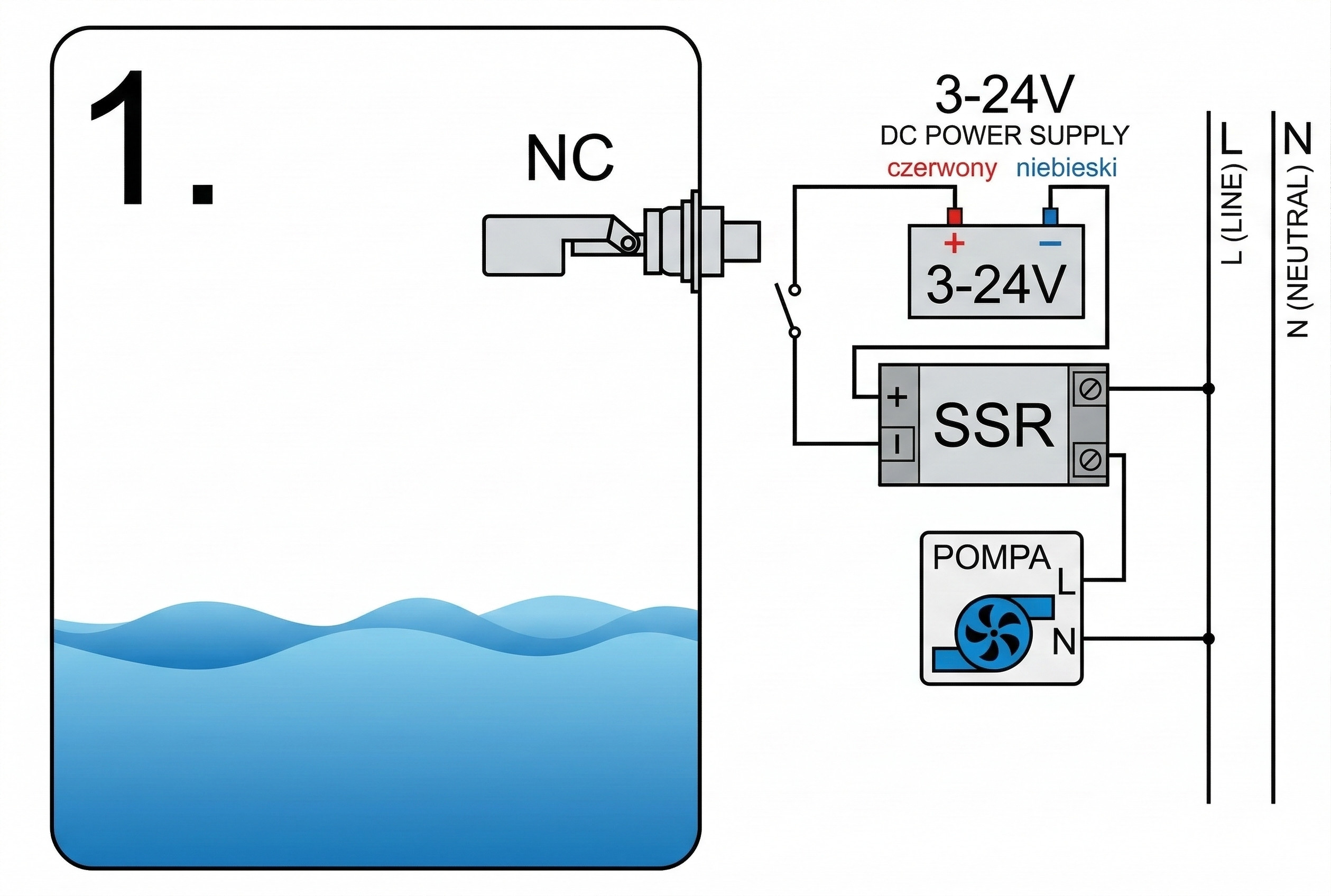
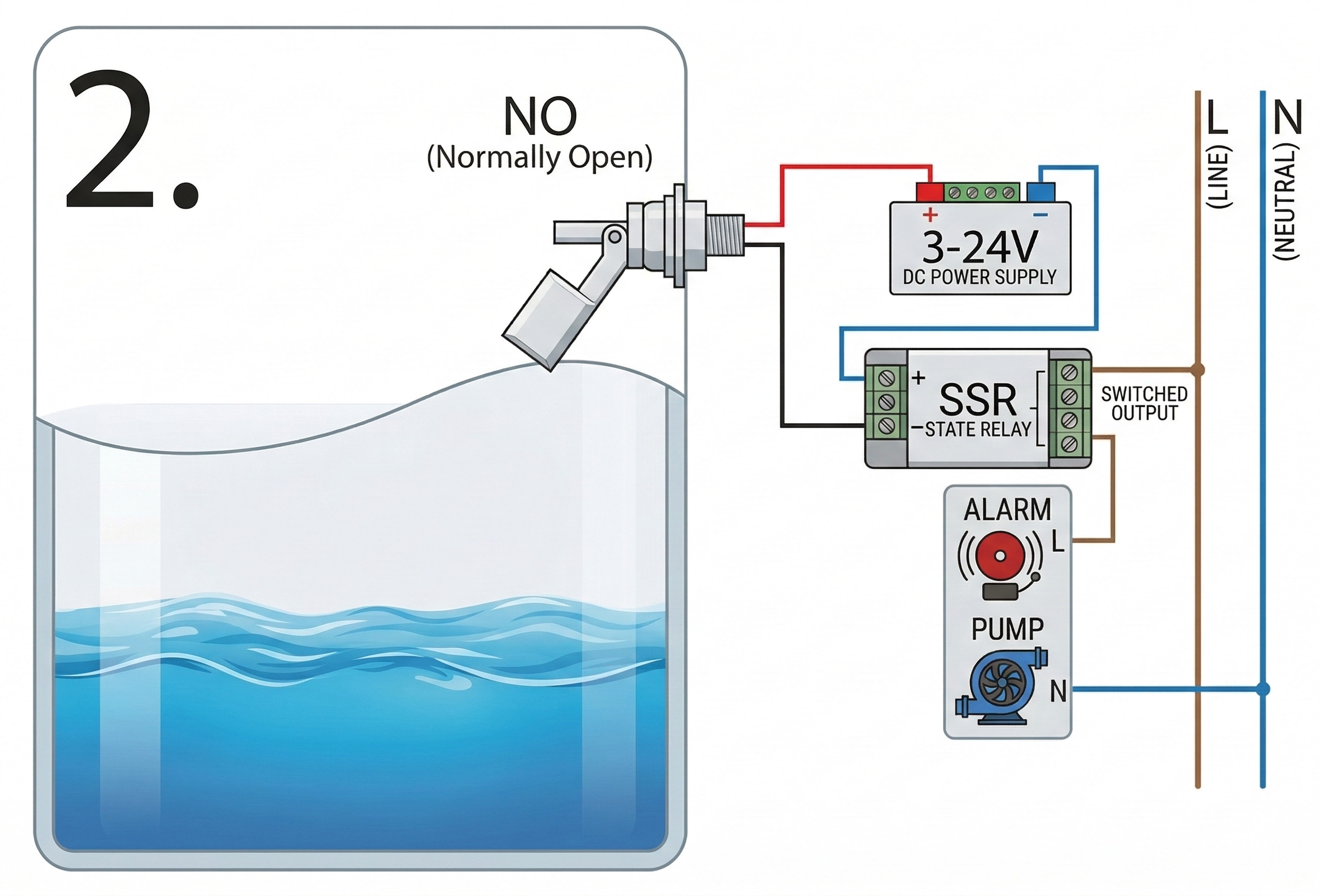
To ensure maximum safety and durability of the device, it is recommended to use SSR (Solid State Relay) modules. This allows for the separation of the low-voltage control circuit (3-24V DC) from the power circuit (e.g., 230V AC pump).
Example 1: NC Configuration
Typically used for dry run protection or fill control.
- DC power (3-24V) connected in series with the sensor.
- Signal controls the SSR relay input.
- SSR turns on the pump when the liquid level is low.
Example 2: NO Configuration
Used for overflow alarm systems or automatic emptying.
- Sensor closes contacts after the float is raised.
- Triggers an audible alarm or extraction pump.
- Recommended control via a relay module.
⚠ SAFETY NOTE
Despite the high rated voltage of the reed switch, it is not recommended to directly switch large inductive loads (pump motors, solenoid valves) without an additional relay or snubber circuit. Direct connection of a high-power pump may lead to sticking of the reed switch contacts.
5 Set Contents
- 1x ACTii AC6669 float switch
- 1x M16 mounting nut
- 1x Rubber gasket (black)